
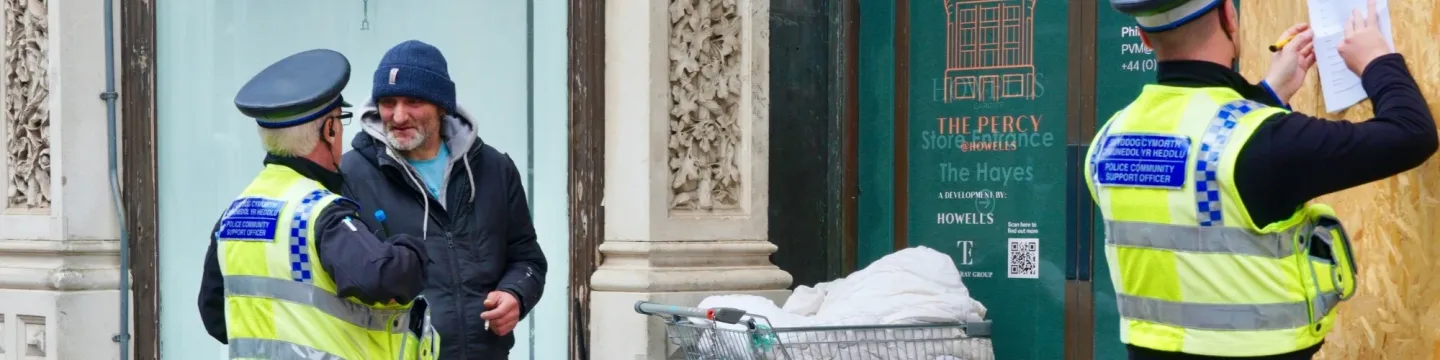
The Vagrancy Act, enacted over 200 years ago, makes it illegal to sleep rough or beg in England and Wales. If charged, it holds a £1,000 fine—a cost that someone on the street clearly cannot afford.
This outdated and atrocious law has no place today.
The Vagrancy Act does not help end homelessness. It pushes people away from city centres and support services, often leading them to even more precarious situations.
We thought the Vagrancy Act had ended when it was repealed in February 2022. But over two years later, people on the street are still being arrested, and unfortunately, there is no end in sight.
*A law repeal is removing or reversing a law, either in part or whole.
Why does the Vagrancy Act exist?
The Vagrancy Act was passed over 200 years ago in Georgian England. Since then, we have had 78 governments and seven monarchs.
The Act was enforced after a rise in homelessness after the Napoleonic Wars and the social effects of the Industrial Revolution.
- After the war, many men were homeless and had to sleep rough and beg to survive. The Government criminalised these men, who had served their country, making it illegal to use their war injuries to beg for food and money on the street.
- The Industrial Revolution saw a massive influx of people searching for work from rural areas to cities. The UK was shifting from handmade goods to machine-made ones. This mass migration strained housing stock, and many people who moved for work could not find a place to live and ended up on the streets.
The repeal of the Vagrancy Act that never happened
Charities have campaigned against the Vagrancy Act for decades. But there has been little discussion in government about it until recently.
In 2021, the Conservative Government promised to repeal the Act. Then-Prime Minister Boris Johnson said, “No one should be criminalised simply for having nowhere to live, and I think the time has come to reconsider the Vagrancy Act”. The Conservatives kept their promise and repealed it as part of the Police, Crime, Sentencing and Courts Bill, passed in April 2022.
So, that means the Vagrancy Act is no more… right? Not quite. The repeal has not yet been ‘enacted’, meaning it is still in force.
All legalisation has a section on ‘commencement’, which sets out when parts of an Act come into force. The clause to repeal the Vagrancy Act was excluded and there is no date for the repeal to go into effect. The Government claimed this allowed for more consultation and promised to repeal the law within 18 months.
In reality, the Government had not set a start date for the Vagrancy Act. It “needed” to bring in replacement legislation before it could be repealed. This replacement legalisation was the Criminal Justice Bill.
The Criminal Justice Bill
Introduced in November 2023, the Criminal Justice Bill would have criminalised “nuisance” rough sleeping and fined people up to £2,500. It also included arresting or fining people for an “excessive odour” or “appearing like they might sleep rough”.
It faced heavy criticism. After the government changed and Parliament dissolved, it will not progress further.
Where does this leave us?
The new Labour Government’s manifesto commitment to getting Britain back on track to ending homelessness must prioritise repealing the Vagrancy Act.
From April 2022, when the Government said it would repeal the Vagrancy Act, to June 2024, 177 people, including 148 men and 27 women, were arrested under the law.
We hope the new Labour Government will end homelessness and this outrageous law.
We all deserve a place to call home. Criminalising people for not having one is unjust and is not how we end homelessness.
References
- Crisis. (2022). Is it scrapped yet? An update on our campaign to repeal the Vagrancy Act. Retrieved from https://www.crisis.org.uk/about-us/the-crisis-blog/is-it-scrapped-yet-an-update-on-our-campaign-to-repeal-the-vagrancy-act/
- London Assembly. (2024). New data from Zoë Garbett AM: 175 Londoners arrested under Vagrancy law since government pledged to repeal it. Retrieved from https://www.london.gov.uk/who-we-are/what-london-assembly-does/assembly-member-press-releases/new-data-zoe-garbett-am-175-londoners-arrested-under-vagrancy-law-government-pledged-repeal-it
- UK Parliament. (n.d.). Vagrancy Act repeal bill. Retrieved from https://bills.parliament.uk/bills/3511
- UK Parliament. (2024). Vagrancy Act repeal bill. Retrieved from https://bills.parliament.uk/bills/3511
- Wikipedia. (n.d.). Vagrancy Act 1824. Retrieved from https://en.wikipedia.org/wiki/Vagrancy_Act_1824

Follow us on social media